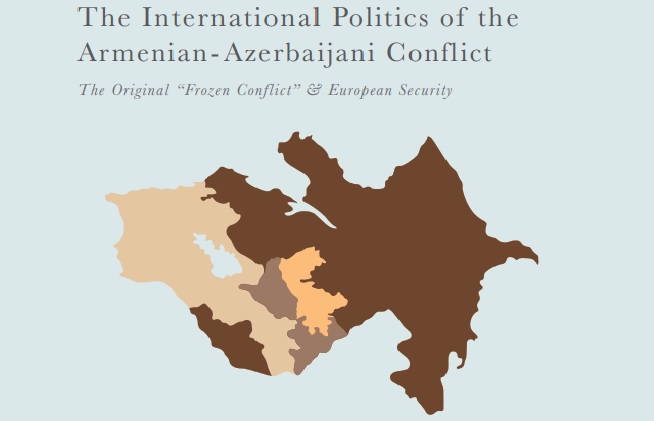
The International Politics of the Armenian-Azerbaijani Conflict
Russia: an Enabler of Jihad?
Op-Ed, Wilfried Martens Centre for European Studies, January 16, 2017
Svante E. Cornell, Russia: an Enabler of Jihad?
Russian officials have had to contain their glee in monitoring recent political events in America and Europe. They appear to think their days in the cold may soon be over. Much has been made of President-elect Donald Trump’s wish to improve relations with Moscow, but the last news out of France appears even more auspicious to Moscow.
The far-right candidate, Marine Le Pen, is known for her pro-Putin sympathies. Now, with François Fillon’s nomination as the center-right candidate, both major contenders in next year’s French presidential election are favorably disposed toward Russia.
These warmer feelings towards Russia are based, mainly, on changing threat perceptions in the West. Since the emergence of the Islamic State and the proliferation of terrorist attacks in Europe and America, many Europeans and Americans appear to view Moscow’s aggression against its neighbors, such as Ukraine and Georgia, as an increasingly esoteric problem.
Particularly after Russia’s intervention in Syria, even on the right many now view Russia not as a threat to the West but as a natural ally in defeating the jihadi threat.
While this notion is gaining popularity, it is at best the triumph of hope over experience, and at worst a dangerous delusion. Russia’s interaction with radical Islam over two decades shows that it is part of the problem, not the solution. In fact, leaders in Moscow have a track record of manipulating radical Islam whenever that has suited their purposes – including systematic collusion with Islamic extremists. A few examples illustrate this policy. Read more
Svante E. Cornell is Director of the Central Asia-Caucasus Institute & Silk Road Studies Program, a Joint Center affiliated with the Johns Hopkins University’s School of Advanced International Studies and the Stockholm-based Institute for Security and Development Policy.
Assassination in Ankara
Op-Ed, Foreign Affairs, January 3, 2017
Halil M. Karaveli, Assasination in Ankara
On December 19, Mevlut Mert Altintas, a Turkish police officer, assassinated Andrei Karlov, Russia’s ambassador to Turkey. His action was apparently meant as retribution for Russian bombings in eastern Aleppo, and he is the latest in a string of right-wing terrorists in Turkeywhose acts have served to draw Ankara back toward the West. Less than two weeks after the assassination, in the early hours of January 1, a gunman believed to have been affiliated with the Islamic State (ISIS) killed at least 39 people at an Istanbul nightclub. If such attacks continue, as they very likely will, they could undermine Erdogan's grip on power, which is what the wave of terror is all about, even if the perpetrators differ.
At this stage, it is impossible to know Altintas’ precise intention, whether he was a “lone wolf” or was directed by others, and what consequences the murder will have. But historical patterns offer some clues. First, Turkey has seen a long line of high-level assassinations carried out by the country’s right wing, made up of Sunni Islamists and Turkish nationalists, who have always been aligned in Turkish politics. The killers have typically had connections—a direct one in the case of Altintas, who was a riot police officer—with the country’s security agencies. Second, assassinations have tended to take place in particular geopolitical circumstances, namely whenever Turkey’s long-standing commitment to the Western security alliance has seemed to be in jeopardy. Read more
Azerbaijan’s Formula: Secular Governance and Civic Nationhood

Kazakhstan 2041: the Next Twenty-Five Years